
Last week, a GitHub project called “Colleague.Skill” became popular.
The function is quite straightforward: Feed the chat records, work documents, and WeChat messages of the departing employees to the large model, and generate an AI avatar that can imitate its tone and working habits.
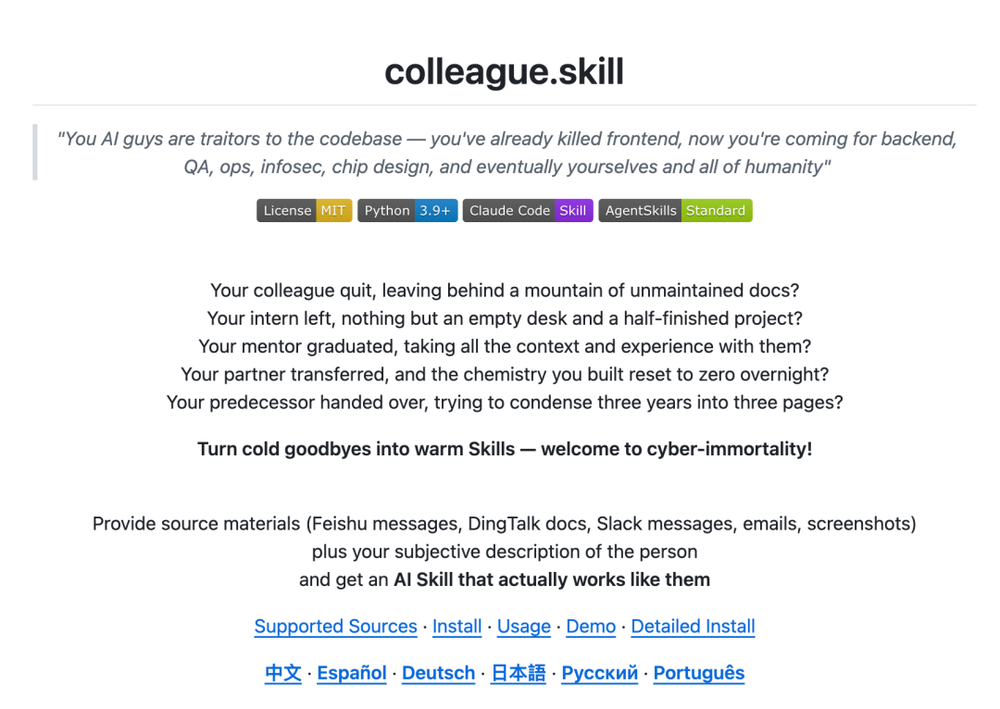
Five days, nearly 70,000 stars.
There was a comment in the comment section that stuck with me:
“The graduating colleagues haven’t vanished; they have merely been distilled into tokens that continue to accompany you.”
This happened not because AI suddenly became stronger, but because over the years, we have documented too many things.
Feishu messages, DingTalk records, weekly reports, post-mortem analyses, meeting minutes… Every digital trace left during work is silently accumulating into a database that can be used for training.
The raw materials needed by AI have already been prepared by us.
01 Which abilities can be distilled?
To be honest, a large part of a person’s professional value can be replicated.
First category: Methodology and process. How do you write the project brief, how do you break down requirements, and how do you facilitate cross-departmental collaboration. Once these logical steps are repeatedly documented, AI can learn them quickly and accurately.
Second category: Expression habits and styles. Your wording, reporting structure, customer communication language. Language patterns are exactly what AI is best at learning, and it can even develop its own “personal style”.
The third category: Conclusions based on historical judgments. What decisions have you made in the past, and what were the final outcomes? The AI can infer your decision-making logic from these conclusions, and create a “simulation of your judgments” system.
In other words: All the “experiences you have ‘outputted’ in the past can, in theory, be distilled.
02 What cannot be distilled is the true moat.
But there is a certain type of thing that current AI simply cannot learn.
That is the way you make judgments when you don’t have complete information.
A person who has been working as an HR for ten years once said: “AI can learn how I write job descriptions, but it can’t learn how I sense when a candidate is lying.”
Where did that feeling come from? It came from the intuition that settled within her after she had talked to thousands of candidates.
It is not included in any document, so the distillation process will not be carried out.
Specifically, the abilities that distillation does not possess are roughly three in number:
One aspect is the cross-context transfer judgment: How can the experience you have gained in industry A be effectively applied to industry B? This transfer process essentially involves making creative analogies. Currently, AI’s capabilities are unable to replicate this process.
The second is making choices in ambiguous situations: when there is no definitive answer, the information is incomplete, and the interests of various parties are in conflict, how do you decide which direction to take? Such judgments are based on values and courage, not data.
The third is the ability to motivate others: How do you get a rebellious subordinate to start trusting you? How do you stabilize the team’s mood when the project is on the verge of collapse? The influence between people relies on on-site perception and real-time response, and this is the true boundary of AI avatars.
03 What does your value map look like?
So the real lesson this incident teaches us is not “AI is going to take away all our jobs”.
Rather, the question is: How much value do you have that exists beyond the documents?
If you have been working for five years and all the core values can be organized into a Wiki, then you really deserve to be cautious.
But if your judgment comes from a lot of unstandardized practical experiences, your influence stems from genuine interpersonal relationships, and your creativity arises from the cross-industry exchange of experiences, then what AI distills out is merely your shadow.
And shadows cannot exist independently.
04 Regarding the issue of career value, there is a certain rule:
The more proactive and mobile a person is, the harder it is to replicate them.
Because every time one changes jobs, it’s like refreshing that “unexplainable” part.
You entered a new industry, met new people, and made decisions in a situation where there were no historical documents to refer to.
Your judgment is developing, and your experience is taking on new forms.
That’s what AI cannot distill.