
In the 1930s, research into obtaining energy from atomic nuclei began. Nuclear reactors were built in the 1940s, and nuclear power plants in the 1950s. Since then, nuclear energy development technology has matured significantly.
Half a century ago, small devices powered by nuclear energy existed. Since then, the question has frequently arisen: when will we be able to use nuclear batteries in our daily lives that provide “uninterrupted power”? Naturally, nuclear batteries have become one of the new directions for nuclear energy research.
A nuclear battery, also known as a radioisotope battery, is a device that generates electricity by utilizing the energy released from the decay of radioactive isotopes—such as alpha particles, beta particles, and gamma rays—or the thermal, optical, or ionizing effects they induce.
It is not a completely new concept; in fact, nuclear batteries have existed for many years. Over the past sixty years, nuclear batteries have been successfully used in military satellites, underwater listening devices, and remote, difficult-to-man-station navigation and weather detection facilities. They were even taken to Mars by NASA’s Perseverance and Curiosity rovers.
Another type of radioactive battery is already used in medical implants and sensors. Nuclear batteries used in pacemakers can be directly implanted in the human body and, with proper sealing, will not cause any harm.
Because they can operate for several years without human supervision or maintenance, fuel cells, chemical batteries, and solar cells cannot match them. However, current nuclear battery devices all face the same problem: low energy conversion efficiency and low energy density.
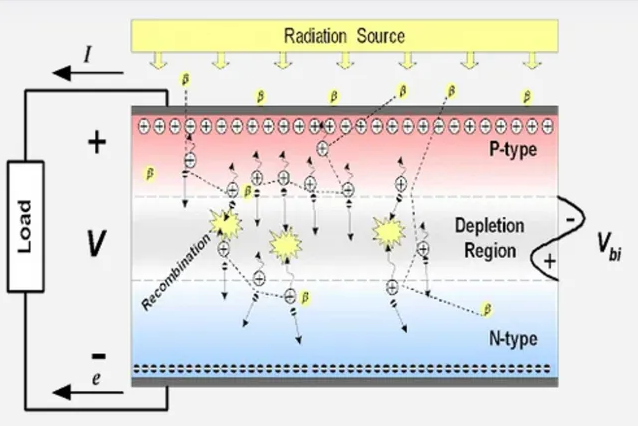
Recently, research in the field of nuclear batteries has seen some new developments, which are expected to break through the limitation of low energy conversion efficiency and significantly improve the efficiency and lifespan of devices. The US nuclear materials company NRD LLC has launched a solid-state nuclear battery, claiming that it can provide power for over a century without maintenance.
Meanwhile, fusion energy startup Avalanche Energy has won a $5.2 million contract to manufacture radioactive batteries capable of powering laptop-sized systems for months. This battery weighs only a few kilograms but has an energy density exceeding 10 watts per kilogram.
Currently, lithium-ion batteries have a wide range of applications, from wearable devices to grid-scale energy storage facilities, thanks to their extremely high energy density, storing up to 300 watt-hours (Wh) of energy per kilogram.
In contrast, radioactive nuclear batteries produce only about 2 Wh of energy per kilogram, with an energy conversion efficiency of only 5% to 10%. Their high cost and radioactive contamination significantly limit their application.
Recently, fusion energy startup Avalanche Energy won a $5.2 million (approximately RMB 35.46 million) contract as part of the Defense Advanced Research Projects Agency’s (DARPA) “Rads to Watts” program, aiming to develop next-generation, more compact, durable, and higher-energy-density nuclear batteries.
Under this contract, Avalanche Energy will manufacture a radioactive nuclear battery capable of powering a laptop-sized system for months, with an energy density exceeding 10 watts per kilogram. This represents a significant leap in power output for radioactive batteries.
Avalanche Energy is reportedly focusing on developing solid-state microfabricated nuclear batteries that can convert alpha particles released by radioactive isotopes into electrical energy (alpha-volt batteries). This is very similar to how photovoltaic cells convert sunlight into electricity. These batteries can convert the kinetic energy of alpha particles into usable electrical energy to power devices such as laptops.
Avalanche will use particle accelerators and active radioactive isotopes to test the operational stability of the batteries. During the project, Avalanche will manufacture degradation-resistant microchips that will be used in the alpha-volt batteries and ultimately in fusion devices.
The company stated in a press release, “The same batch of fusion devices that produce high-energy alpha particles will also produce high-energy neutrons. The generated neutrons can also efficiently produce the radioactive isotopes needed for the Rads to Watts project, thus creating an enhanced supply and technology flywheel around Avalanche’s core fusion platform.”
Meanwhile, US nuclear materials company NRD LLC has unveiled a solid-state nuclear battery that it claims can provide power for over a century without maintenance. This device targets ultra-low-power electronic devices operating in remote or difficult-to-maintain environments.
NRD LLC states that its NBV series utilizes a nickel-63-driven beta-volt design to generate electricity through radioactive decay. The system employs a sealed solid-state architecture, with the beta-volt device converting the energy released during beta decay into current.
Unlike conventional batteries, these rely on a continuous decay process, enabling them to operate for extended periods at extremely low power levels. NRD claims the battery can provide power output from 5 nanowatts to 500 nanowatts, with its long lifespan depending on the half-life of nickel-63.
The device operates at a voltage range of 1.0 V to 20.0 V, has a nominal current range of 7.5 nA to 33 nA, and boasts a compact size of 20 mm x 20 mm x 12 mm. These specifications place the device firmly in the ultra-low power category, making it suitable for sensors, data logging systems, and monitoring equipment requiring continuous but minimal energy input.
The company states that the system is designed for use in industrial monitoring, environmental sensing, and security systems, as well as AI-driven autonomous platforms requiring continuous low power to maintain system status. Furthermore, this battery is suitable for remote deployment, including infrastructure monitoring and long-term health tracking systems, where maintenance may be difficult or impossible.
Besides the United States, China has also made new breakthroughs in the field of nuclear batteries in recent years.
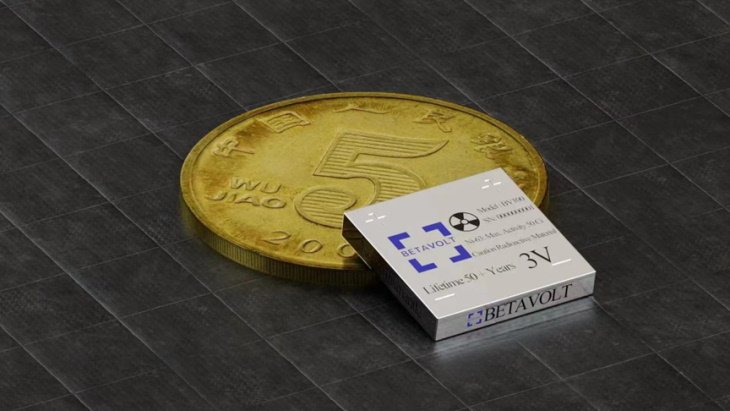
In January 2024, Beijing Betavolt New Energy Technology Co., Ltd. (hereinafter referred to as “Betavolt”) announced the development of a miniature atomic energy battery. The research team utilized nickel-63 nuclear isotope decay technology and diamond semiconductors to miniaturize, modularize, and reduce the cost of the atomic energy battery.
The technology involves generating current through the semiconductor transition of β particles emitted from a nickel-63 radioactive source. The Betavolt team developed a single-crystal diamond semiconductor only 10 micrometers thick, placing a 2-micrometer-thick nickel-63 sheet between two diamond semiconductor converters to convert the decay energy of the radioactive source into current.
The company’s first product—the BV100 battery—has a power of 100 microwatts, a voltage of 3 volts, and a volume of 15×15×5 cubic millimeters, smaller than a coin. Zhang Wei, Chairman and CEO of Betavoltaic, stated that the new nuclear battery can achieve stable power generation for 50 years, requiring no charging, maintenance, or external radiation.
The reliability and longevity of nuclear batteries are difficult for other batteries to replace. Although there is still a long way to go from the laboratory to practical application, the future of never-recharging mobile phones and new energy vehicles without range anxiety remains promising.