
The R&D department has been implementing AI coding for some time, but the actual results have fallen far short of the initial expectation—”faster coding, better everything.”
On the one hand, R&D costs have not only failed to decrease but have actually increased significantly. On the other hand, the product department is struggling to keep up with the R&D team’s accelerated pace, passively being led by them, and the original product management has become virtually ineffective. An even bigger problem is that the sales team reports that despite the introduction of many new features, sales performance has not improved; instead, the complexity of the products has increased the difficulty and workload of explaining them to customers.
Therefore, it seems necessary to clarify the relationship between “engineering productivity” and “value creation.”
01 “Engineering Efficiency” and “Business Results”
The competition in the software and SaaS industry has long since shifted from a “scale race” to a “profit survival” strategy.
Many domestic software companies have yet to achieve the “Rule of 40,” while the entire overseas industry has widely adopted the “Rule of 60” as a benchmark. There’s no other way; in the current industry climate, companies must prioritize profitability to survive the downturn.
In this process, the engineering department naturally becomes the core of the pressure. R&D leaders face the same question every day: How to improve R&D efficiency? How to prove it with data?
Against this backdrop, the emergence of Vibe Coding seems to have hit the nail on the head in the software engineering field. Various AI programming tools can quickly generate code, alleviate PR bottlenecks, liberate engineers from repetitive and tedious work, and significantly improve coding speed.
In fact, among the many areas affected by AI, software engineering ranks first.
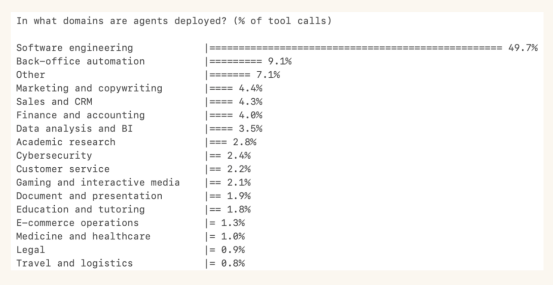
Thus, the logic of “AI coding = improved efficiency = better company” has been adopted as a golden rule by many software companies. It seems that as long as coding speed is improved, all the development problems of software companies can be solved.
Few realize that this perception isn’t just a misunderstanding, but a fatal flaw that can cripple a company—mistaking the “means” for the “end,” equating “coding speed” with “core competence.”
In fact, the software industry has never lacked attempts to be “faster.” From early agile development to various efficiency models, they were all hailed as “speed-boosting magic weapons,” but ultimately failed to fundamentally solve the core problems hindering company growth.
Today’s AI coding might just be another “speed frenzy.” And after the frenzy, will they have won in terms of speed, or lost in terms of funding, customers, and market opportunities?
This relationship between “engineering efficiency” and “business results” is a question that all software companies must soberly examine.
02 Is “speed” more important, or “doing the right thing”?
Many software companies have fallen into a fatal trap: frantically chasing the speed of AI coding and blindly piling on features, while ignoring the most fundamental question—what do customers truly need?
In reality, how many lines of code you write or how quickly you iterate features has absolutely nothing to do with the customer. The ultimate goal of engineering development is to solve their business pain points and create sustainable value for them.
The biggest limitation of AI coding is precisely that it can only increase the “speed of software development,” but it cannot determine “what functions should be implemented.” This is like replacing a 150-horsepower engine in a regular car with a 2000-horsepower racing car engine—the car will certainly become incredibly fast, but the final result is either winning the race or losing control and plunging off a cliff; there is no third possibility.
The truth about AI coding is far more brutal than this analogy: it doesn’t help you determine the value direction of the software; it only accelerates project failure in a state of self-driving-like confusion. It enables programmers to write code efficiently, but it also enables them to efficiently do useless work—such as developing features customers don’t use, increasing the number of lines of code, and writing buggy code, ultimately leading the company to rapid mediocrity through seemingly efficient internal friction.
For software companies, this principle is even more crucial: the speed improvement brought by AI coding is meaningless if it is divorced from customer value.
This is not an empty theory, but has a clear verification method. A single test, “feature adoption rate,” can reveal the truth. For example, if you quickly develop a bunch of features using AI coding, but customers use less than 30% of these features, it’s enough to conclude that a large amount of R&D costs have been wasted. This accumulated “AI technology debt” is already heavy enough to crush a small to medium-sized software company.
To quote Peter Drucker: “There is nothing so useless as doing efficiently that which should not be done at all.“
03 The “True Value” Hidden by the “Miracle of Speed”
Regarding AI coding, a core issue must be clarified: the essence of engineering efficiency for software companies is no longer “how fast to write code,” but rather “how quickly to increase customer value.” Understanding the meaning of “speed” in this way is what gives AI coding its true value.
AI coding is undoubtedly a powerful “force multiplier,” but its value is realized only on one prerequisite: companies must clearly understand the true meaning of “faster” and “more,” rather than getting caught up in an obsession with “speed.”
Simply put, “faster” here doesn’t mean writing code or completing development faster, but rather adding value to customers faster; “more” doesn’t mean developing more features, but ensuring that each developed feature has a higher utilization rate and truly serves the customer’s business needs.
In reality, many engineering and R&D centers have fallen into a fatal misconception: they treat “completing product development on schedule” as a departmental KPI, and AI coding can help them “successfully” achieve this goal, forgetting the ultimate meaning of engineering and R&D.
In fact, even the most astonishing coding speed is not a miracle; truly creating value for the product and for customers is the true value that AI coding should pursue.
Frankly, for SaaS companies, the practical significance of rapid coding is far less than imagined.
This is because the development logic of SaaS, aside from the initial framework building and completion of the main software body where coding speed is a concern, involves mostly small iterations and optimizations—in this scenario, AI coding is essentially useless.
More importantly, if the main software body is completed using AI coding, subsequent changes, iterations, and maintenance become exceptionally difficult because engineers are unfamiliar with the overall structure generated by AI.
As a result, any initial speed gains from AI are ultimately negated by later chaos and inefficiency. Overall, it may not save time and could even increase costs.
Final Thoughts
Whether AI-powered coding is truly useful cannot be determined by programmers’ subjective feelings, and companies should not be misled by the apparent benefit of “faster coding.”
The most feasible approach is to quantify its value by referencing both internal company metrics and external user metrics—let the data speak for itself and use it according to established guidelines.
Internal metrics should focus on indicators such as ARR and NRR, which directly reflect the company’s core competitiveness and customer retention capabilities. External metrics should focus on feedback indicators such as product usage rate and the number of customer work orders. By analyzing actual customer usage behavior and feedback, it’s possible to determine whether the functions developed using AI-powered coding meet the requirements and the speed of feature iteration.