
In the minds of many, urban waste is perceived as an endless stream—a phenomenon that once made “cities besieged by garbage” a grave environmental concern. In late February 2020, China’s largest landfill—the Jiangcungou Landfill in Baqiao, Xi’an—officially ceased operations. Spanning over 1,000 mu(Chinese unit of land measurement that is commonly 666.7 square metres)—an area equivalent to 100 football fields—this facility was originally designed to operate for 50 years; however, due to the rapid pace of urban waste generation, it was forced into early “retirement” after just 25 years of service.
Yet today, many cities no longer require landfills for household waste. So, where does the garbage go?
The answer is: it burned down.
In the same year that the Jiangcungou Landfill in Baqiao, Xi’an, was closed, incineration surpassed sanitary landfilling to become the primary method for treating urban domestic waste.
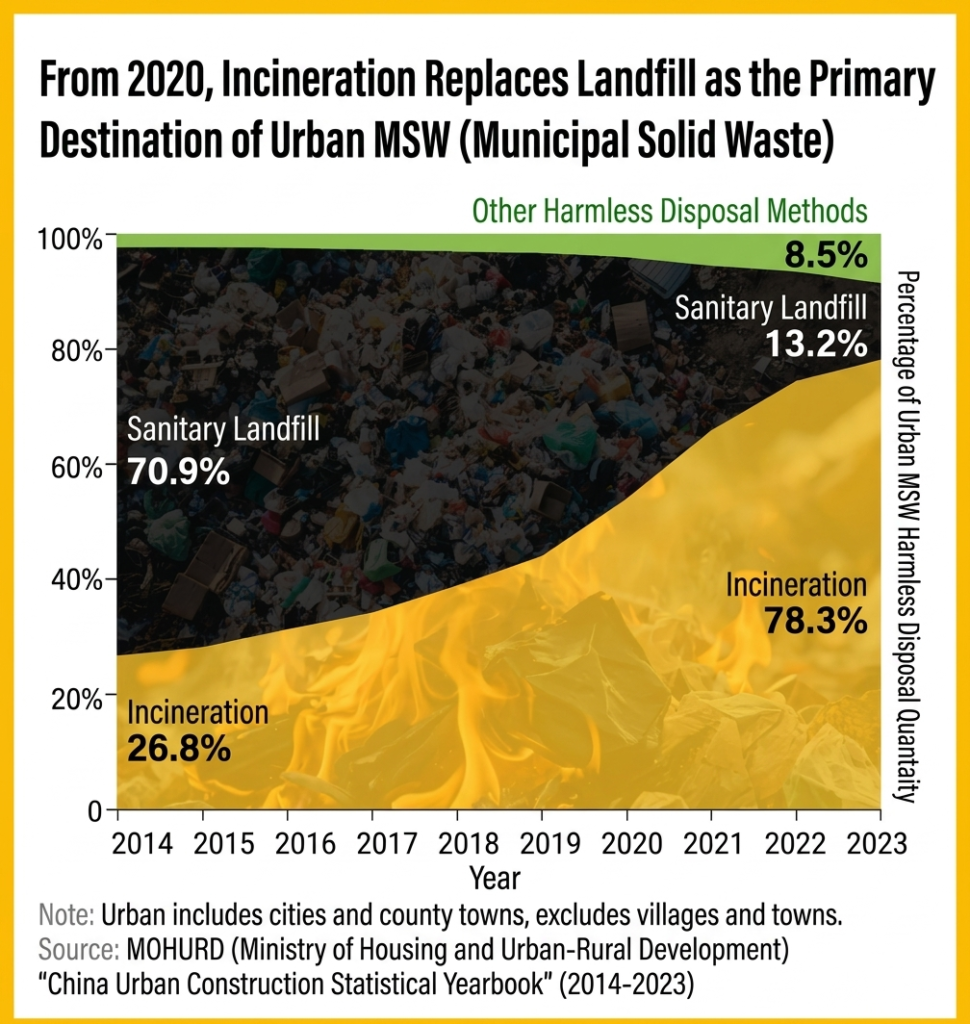
By 2023, 78.3% of urban household waste was disposed of through incineration, while the share of sanitary landfilling had declined to 13.2%.
How did this pattern emerge?
01 | How did incineration become the mainstream method of waste disposal in China?
China’s waste incineration industry got off to a relatively early start; in 1985, the Shenzhen Municipal Sanitation and Comprehensive Treatment Plant imported two complete waste incinerator units from Mitsubishi Heavy Industries. However, due to the low calorific value of municipal solid waste at the time, the project did not operate smoothly. It was not until the turn of the century—with economic growth and rising living standards—that the calorific value of municipal solid waste finally increased significantly.
In 2005, the Build-Operate-Transfer (BOT) model emerged within the waste incineration sector, allowing private enterprises to participate in infrastructure construction and provide public services to society. Concurrently, to accelerate the construction of waste-to-energy incineration plants, relevant enterprises were granted preferential treatment regarding grid connection and on-grid electricity tariffs; specifically, grid operators were mandated to purchase the entire output of electricity generated by waste incineration projects. Consequently, a large number of enterprises began to enter the waste-to-energy industry.
In 2016, the Ministry of Ecology and Environment implemented a set of regulatory policies for waste-to-energy plants based on the “Install, Display, and Connect” framework: “Install” (installing automated pollution source monitoring equipment), “Display” (erecting screens in prominent locations to display pollution emission data), and “Connect” (linking the enterprise’s automated monitoring system directly to the environmental protection authorities’ network). These measures significantly strengthened information disclosure and public participation. On January 1, 2020, the Ministry of Ecology and Environment launched the “Public Platform for Automated Monitoring Data from Municipal Solid Waste Incineration Power Plants” (hereinafter referred to as the “Incineration Plant Monitoring Platform”). This platform enables the public to access the internet and query the emission concentrations of pollutants—such as nitrogen oxides and sulfur dioxide—as well as furnace temperature data (which influences the generation of dioxins) for any waste incineration plant across the country.
As regulatory policies for waste incineration plants gradually took shape, waste incineration was officially established as the dominant method for municipal solid waste treatment in China, and waste incinerators subsequently began to spring up across the country like mushrooms after rain.
Investigators analyzed data published on the monitoring platform for waste-to-energy plants, compiling the designed processing capacities of incinerators at various operational facilities across the country. This capacity surged from 238,000 tons per day in 2016 to 1.166 million tons per day in 2024. Based on the standards for urban domestic waste incineration projects—issued by the Ministry of Housing and Urban-Rural Development—which stipulate an ideal annual operating duration of 8,000 hours (approximately 333 days) for waste incinerators, the nation’s designed waste incineration capacity reached 388 million tons per year by the end of 2024, thereby exceeding the total volume of urban domestic waste collected.
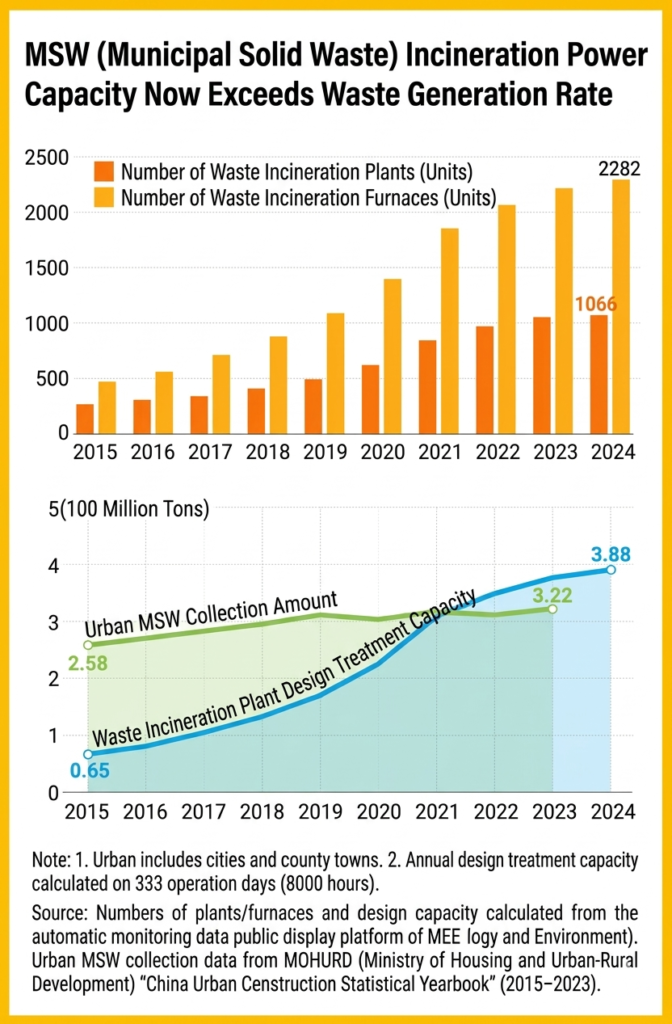
The rate at which waste incinerators burn refuse has outpaced the rate at which urban residents generate household waste; unexpectedly, this has led to a situation in some localities where waste-to-energy plants have been forced to shut down temporarily due to a shortage of waste to burn.
Investigators analyzed the 2024 operational data for 2,138 waste incinerators—monitored via a dedicated platform for waste-to-energy plants—and found that 1,267 of them operated normally for more than 90% of the year, representing a proportion of 59.2%.
It should be noted, however, that an incinerator’s operating time does not strictly equate to its actual operational load. Take, for instance, the Bao’an Energy Ecology Park—Shenzhen’s largest waste-to-energy facility. According to the Announcement on Information Regarding the Prevention and Control of Environmental Pollution from Solid Waste in Shenzhen for 2024, published by the Shenzhen Ecology and Environment Bureau, this facility processed an average of 8,985.4 tons of household waste per day in 2024. Given its designed processing capacity of 8,000 tons per day, the plant effectively exceeded its key performance indicators (KPIs); meanwhile, the average annual operating time for its 12 incinerators stood at 90.4%.
Conversely, last year also saw 107 incinerators remain offline for more than 50% of the time—meaning that for at least half the year, these units were effectively sitting idle—accounting for 5.0% of the total.
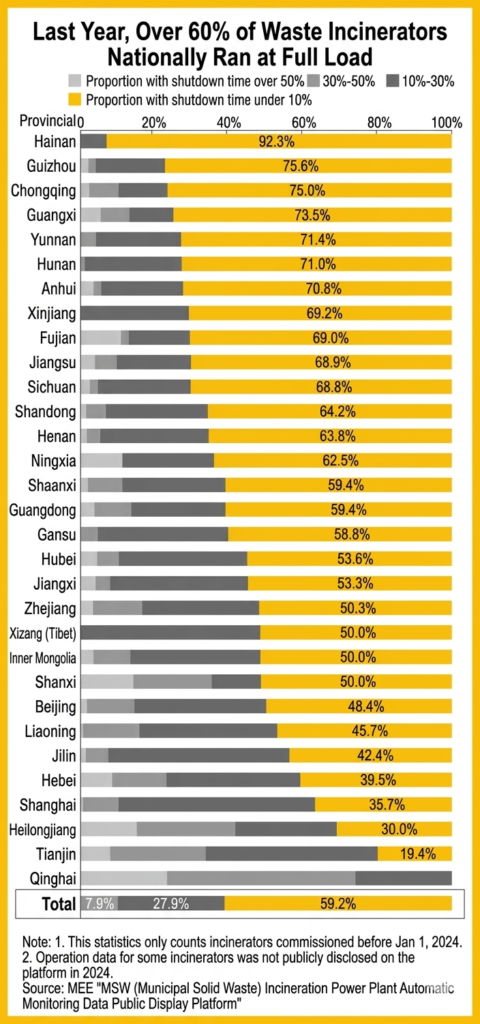
Media outlets have previously reported on the phenomenon of waste incineration plants in certain regions “going hungry”—that is, operating below capacity due to a shortage of waste:
In July 2020, the Xianyang Urban and Rural Domestic Waste Incineration Power Generation Project was connected to the power grid. Local media reports noted that while the facility has a daily processing capacity of 1,500 tons, the main urban area of Xianyang generates only 800 tons of domestic waste per day; consequently, the project faces the challenge of an insufficient waste supply.
02 | What Should Be Done When Waste Incineration Plants Are “Starving”?
In July 2021, while conducting an inspection in Henan Province, the Fifth Central Ecological and Environmental Protection Inspection Team issued feedback noting that “some newly constructed waste-to-energy plants are ‘starving’—specifically, the actual operating load of the municipal solid waste incineration power generation project in Hebi City, Henan, stands at a mere 50%.”
In response, by the end of October 2022, Hebi City had implemented a series of measures. These included transporting all municipal solid waste from its subordinate townships, counties, and districts to the facility; coordinating the transfer of 90,000 tons of municipal waste from the neighboring city of Anyang; and excavating existing stockpiles—specifically unearthing 91,000 tons of “aged waste” (waste that has undergone years of landfilling or natural decomposition through accumulation) to bridge the supply gap.
However, Hebi City is not the first municipality to turn its attention to aged waste. In 2021, seeking to address issues related to emergency landfill capacity while simultaneously pursuing the benefits of emission reduction and power generation, Jinhua City in Zhejiang Province launched a plan to excavate and incinerate 260,000 tons of aged waste over a period of three to four years.
Nevertheless, the excavation of aged waste presents potential environmental risks, such as methane leakage and leachate seepage. Furthermore, compared to fresh waste, aged waste possesses a relatively low combustible content; consequently, it must be blended with fresh waste in specific proportions to ensure effective incineration.
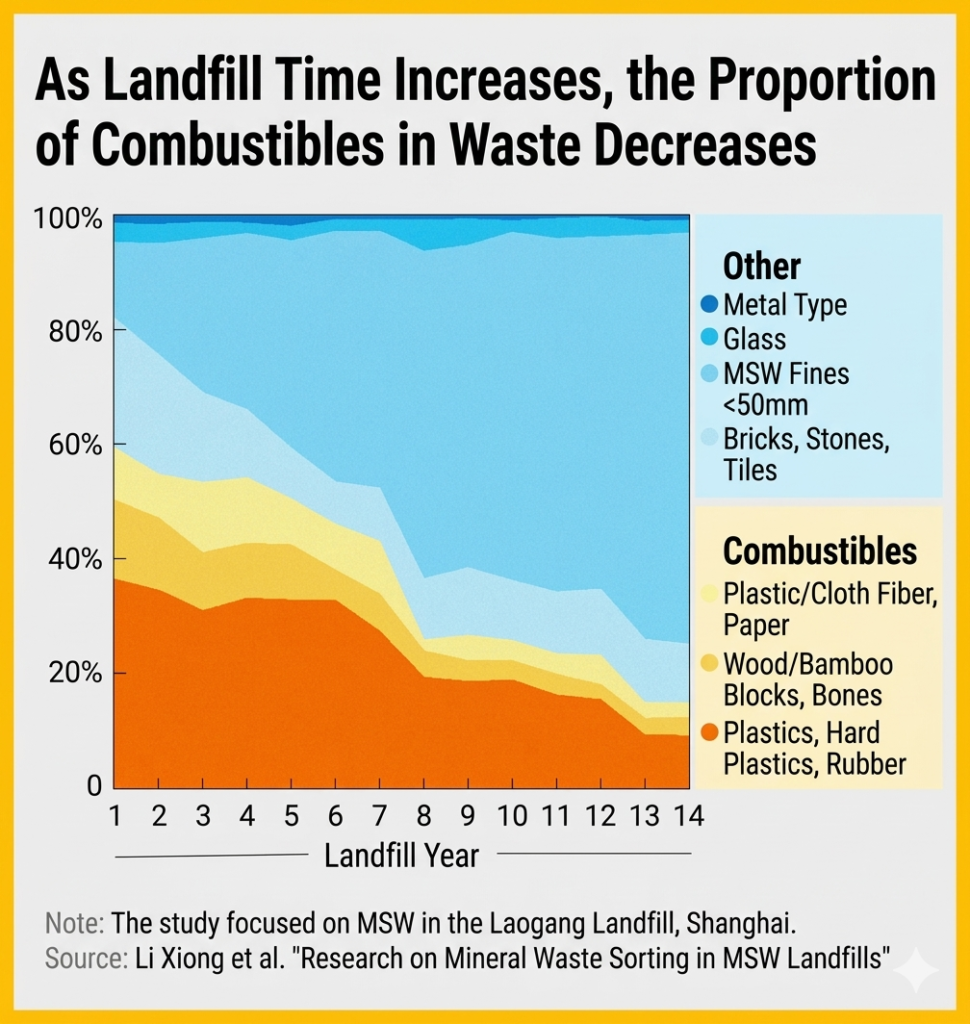
However, the excavation of aged landfill waste is not driven solely by a shortage of waste available for incineration.
In September 2024, Huangpu District, Guangzhou, released the “Public Notice on the Environmental Impact Assessment Report (Pre-Approval Submission) for the Waste Excavation Project at the Guangzhou Xingfeng Emergency Landfill.” This initiative proposes transitioning the renowned Xingfeng Landfill from a closed state to an active excavation state. The plan entails a four-year process to extract the aged waste contained within the site and incinerate it—a measure necessitated by the dwindling remaining capacity of the landfill.
After municipal solid waste undergoes incineration for power generation, residual byproducts—such as fly ash—remain. Due to technical limitations, a significant portion of these residues cannot be further recycled or repurposed; consequently, they must be disposed of via landfilling. As of the end of 2023, Guangzhou’s existing landfills possessed a remaining storage capacity of 3.02 million cubic meters specifically designated for fly ash. Assessments indicate that this remaining capacity is projected to be exhausted by 2030; therefore, it has become necessary to excavate the aged waste so that, through incineration, its volume can be substantially reduced.
Indeed, when waste-to-energy incineration plants in many major cities were initially planned, they were designed with the specific objective of addressing and resolving the issue of aged landfill waste.
03 | With so many incineration plants, is there still waste that needs to be landfilled?
However, it is also worth noting that although China’s waste incineration capacity now exceeds the volume of waste collected in urban areas, approximately 10% of waste still requires disposal via landfilling. These areas are primarily concentrated in county-level cities and towns.
Take Shaoyang City in Hunan Province as an example: investigators, upon reviewing the city’s 2024 Information Bulletin on the Prevention and Control of Environmental Pollution from Solid Waste, discovered that two waste incineration plants located near the city center operated at overcapacity throughout the year (at rates of 125.6% and 101.2%). In contrast, two incineration plants situated in the subordinate county-level areas operated at load rates of only 51.9% and 10.7%, respectively. Across the entire region, the collective annual design capacity of the waste incineration plants—totaling 911,400 tons of domestic waste—was utilized to process only 681,300 tons. Meanwhile, six of the nine counties under Shaoyang’s jurisdiction continued to rely on landfilling for domestic waste disposal, burying a total of 267,900 tons of waste over the year.
According to research conducted by Yang Jing and her colleagues at the Development Center of the Ministry of Ecology and Environment, more than 75% of county-level regions nationwide face a shortfall in domestic waste incineration capacity. This deficit is particularly pronounced in the Northwest (the Shaanxi-Gansu-Ningxia and Qinghai-Tibet-Inner Mongolia-Xinjiang regions), the Northeast (the Heilongjiang-Liaoning region), and Central China (the Yunnan-Sichuan-Chongqing and “Two Lakes” regions). Conversely, some county-level regions that do possess incineration plants face the opposite problem: an oversupply of processing capacity and a chronic shortage of waste to process—a situation often described as “starving” the plants.
To return to the example of Shaoyang City: the waste incineration plant located in Xinshao County was able to operate at full capacity because the waste it processed originated not only from its own county but also, in part, from the urban core of Shaoyang City. The incineration plant in Dongkou County, however, had far less waste available to burn; in 2024, it processed a mere 22,900 tons of waste, despite having a designed processing capacity of 213,600 tons.
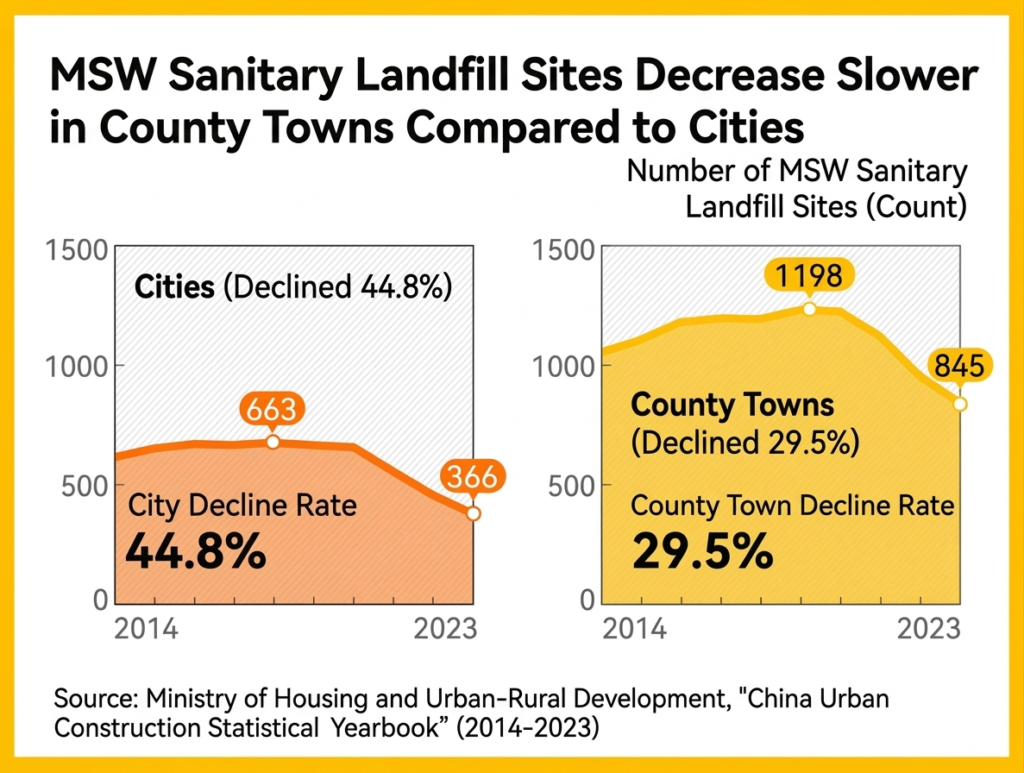
Consequently, we observe that while the number of sanitary landfills for municipal solid waste in urban areas has declined from a peak of 663 to 366—a decrease of 44.8%—the decline in county-level areas has been significantly smaller, standing at 29.5%.
Reliance on sanitary landfills persists in certain county-level regions.
But regardless, China is taking concrete action to quietly extricate itself from the crisis of being besieged by waste—gradually transforming from an environmental laggard into a top performer.